Forest Park
The ChangelingForest Park, particularly its Northern Forest, is where New York City’s ordinary streets give way to a wilderness that conceals Emma Valentine, a cave, and the troll linked to the Knudsen family’s history. More than five hundred acres of woodland lie within Queens, close enough to the city that Apollo Kagwa can reach the park on foot, yet dense enough to make him feel he has crossed into another world. Its paths, slopes, clearings, and hidden spaces transform the park from a refuge at the edge of the city into the ground on which Apollo and Emma confront the past and recover their son.
Setting and Layers of History
Forest Park occupies a striking position in the novel’s geography: it is both a borough park and a remnant of a much older landscape. Apollo follows an old man through residential streets and across Metropolitan Avenue, watching the built environment change from brick facades to detached homes with aluminum siding. Past Union Turnpike, the houses and roads give way to the park’s northeastern edge. The transition feels less like entering a city park than crossing into a different region, even another world. The Northern Forest’s scale and density make that contrast credible: wilderness persists within the borough, rather than beyond the reach of the city.
The park’s geological and human histories overlap. In Jorgen Knudsen’s account, the Laurentide ice sheet reached New York roughly twenty thousand years ago, laying a glacier about a thousand feet thick across the area before it melted. Jorgen also links the landscape to the Norwegian family history he recounts to Apollo. Nils Knudsen, Anna Sofie, and Petra Mikkelsdatter remained in Queens after the Sloopers traveled farther upstate; at the time, Jorgen explains, the area was farmland, with thousands of acres of forest and green space. In his telling, that wooded terrain offered a suitable place for a creature from the natural world of his homeland to settle. The land for the park was purchased in 1898, and its designers added golf courses and hiking paths, but the hills and pockets of woodland remained places where something large could hide.
The story also sets the park within a broader account of Queens as a landscape repeatedly remade and reinterpreted. Apollo’s thoughts turn to the borough’s earlier marshland, the Old Rockaway Trail, and mastodon remains found during nineteenth-century work at nearby Baisley Pond. Those layers of history make the park more than a patch of undeveloped land: beneath the familiar borough is a succession of older places, each preserved imperfectly in what came after it.
A Wilderness Within the City
The Northern Forest changes Apollo’s sense of distance and safety. After Jorgen leaves bags of Starbucks food at the top of the park stairs, Apollo watches him go, then hides nearby with his suitcase. A police car arrives, and Apollo is warned away from the surrounding homes. Seeking shelter, he crosses into the park and breaks into a locked restroom near the Visitors Center with the mattock he carries in his suitcase. The place is not a romantic refuge at first: it is cold, guarded by locked doors, and close enough to residential streets for the police to patrol its perimeter.
In daylight, Apollo searches for Emma around the Carousel and the George Seuffert, Sr., Bandshell, possible shelters from the weather. He walks until midday without finding her. Within the thickest parts of the Northern Forest, however, the city recedes so completely that he can imagine himself hundreds or thousands of years in the past. The park’s urban location and apparent remoteness coexist: Apollo is still in one of the most densely populated cities in the world, but its woods permit him to lose sight of that fact.
When Apollo later enters the brush, that threshold becomes immediate. He pushes through it with his suitcase, and only a few feet into the trees the streets seem to vanish. The sounds and sensations that take their place are specific and ordinary: trees creaking in the wind, dry leaves crackling beneath his feet, and the winter air. Then he hears what first seems like running water, but proves to be words murmuring around him. The forest is not simply quiet; it feels inhabited by a presence Apollo cannot yet see. Touching the red string on his ring finger, he proceeds as though he has entered a witch’s woods and made an offering.
Emma’s Return and the Route to the Cave
At the park stairs, Jorgen leaves the food as if marking a meeting place. Later, after Apollo has been driven away from the area, he sees Emma emerge from the woods and collect the bags. The woman he recognizes by her torn, dirty maroon coat is gaunt, and a blue radiance surrounds her. She disappears back into the darkness with the food. The brief sighting confirms that she is alive and nearby, but does not give Apollo a way to reach her.
The next morning, he returns to search. When he finds Emma again in the forest, she walks away rather than stopping to reunite with him. Apollo follows the blue light through stands of tulip trees, red oaks, black walnut, black oak, black birch, and pignut hickory. The path grows indistinct as dirt gives way to grass, moss, and fungi. The forest floor carries its own hidden life—earthworms, millipedes, sow bugs, moles, shrews, and other animals—while the changing ground and vegetation make the route feel increasingly removed from the streets outside.
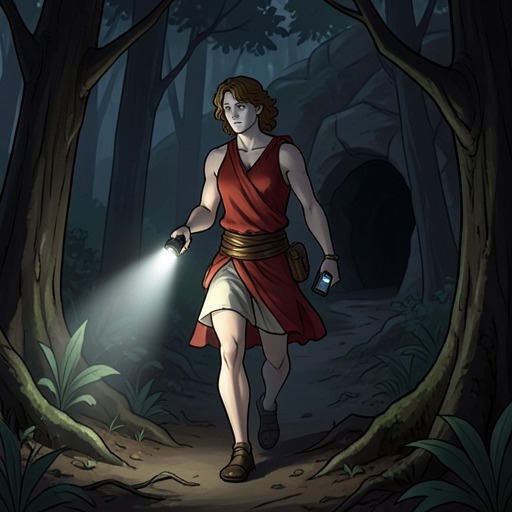
Apollo’s pursuit is also a passage through uncertainty. When the trees crowd out the moonlight, he uses his charged cellphone as a light despite having no signal, following Emma’s footprints in the snow. The trail reaches a clearing where the forest floor is trampled smooth and the surrounding trees lean as if something enormous has forced its way through. Jorgen’s Norwegian words for the creature return to Apollo’s mind. The path then opens onto a bowl-like hollow of rings of gray stone and rubble, with a black cave at its bottom. Emma sits near its edge. Until this point, the cave and the creature have belonged to Jorgen’s story; the visible opening makes that account terrifyingly concrete.
Offerings, Danger, and the Park’s Aftermath
Forest Park serves as the setting for a series of offerings. Jorgen leaves food on the stairs for Emma, who takes it back into the woods. Later, Apollo returns to the same place carrying a covered sheep’s head, then takes it into the park. The sequence links the park’s visible entrances and paths to the hidden encounter at the cave: what appears to be food left in a public landscape is part of an ongoing effort to approach someone living beyond its ordinary human routes.
The danger beneath the forest extends into a tunnel system. During the final confrontation, Apollo sees moonlight at the far end of a passage and a slope of small stones leading toward the outside world, about fifty feet away. The tunnel is both a route of escape and part of the creature’s lair. The park’s hidden terrain has confined Brian Kagwa, but it also offers Apollo and Emma a way out.
After Brian is recovered alive from inside the troll, daylight reaches the creature in the Northern Forest. Its body stiffens, loses its color, turns to stone, and breaks apart until it resembles a mound of boulders or a small hill. Emma carries Brian toward the woods and the path they had taken the previous night. Apollo stays behind to approach the stone that had been the troll’s head. His gesture toward it makes the forest the site not only of danger and rescue but also of a private act of mourning.
The park also holds a quieter memorial. On the way back to Jorgen’s house, Apollo retrieves a grave marker bearing Brian Kagwa’s name from his suitcase and leaves it in the woods near the place where the changeling was born. The marker’s concealed location gives the park a lasting connection to the child’s death even after the troll has been destroyed. Forest Park thus gathers the novel’s competing meanings of wilderness: it is an urban refuge and a place of exposure, a landscape with geological and immigrant histories, a route through which Apollo searches for Emma, and a terrain where family secrets take physical form. Its apparent distance from the city makes the encounter possible, while its closeness to everyday Queens keeps that encounter from belonging to a wholly separate world.